Earth is sweeping up stardust from a nearby interstellar cloud.

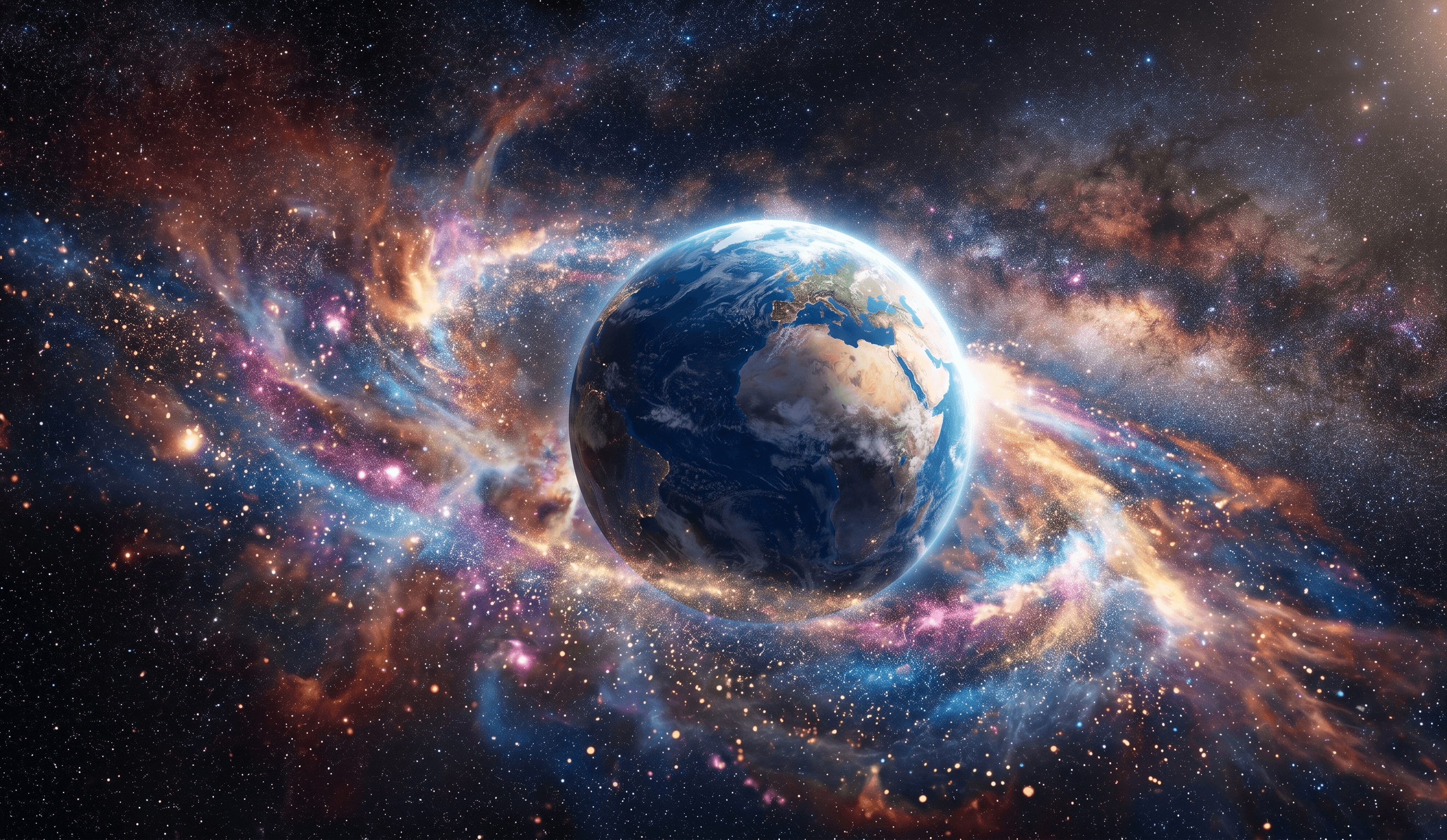
The Sun does not travel through empty space. It moves through a structured, low-density medium of gas, dust, and magnetic fields known as the local interstellar medium. For roughly the last 60,000 years, the solar system has been passing through a specific patch of this medium called the Local Interstellar Cloud, sometimes nicknamed the Local Fluff. Recent measurements from spacecraft, ground observatories, and isotope studies of terrestrial sediments confirm that Earth is actively collecting interstellar dust grains from this cloud — and the process is leaving measurable fingerprints on our planet.
The cloud the solar system is crossing
The Local Interstellar Cloud is a wisp of warm partially ionized hydrogen about 30 light-years across, with a density of roughly 0.3 atoms per cubic centimeter. By interstellar standards it is unremarkable. By solar system standards it is consequential, because the cloud's pressure, density, and magnetic field set the outer boundary of the heliosphere — the magnetic bubble inflated by the solar wind that shields the planets from most galactic cosmic rays.
Data from the Interstellar Boundary Explorer (IBEX) and Voyager 1 and 2, which both crossed the heliopause in 2012 and 2018 respectively, indicate that the cloud's magnetic field is tilted relative to the galactic plane and stronger than expected. This compresses the heliosphere on one side and stretches it on the other, producing the asymmetric shape now mapped in energetic neutral atom emissions.
How interstellar dust reaches Earth
Within the cloud's gas there are submicron solid grains — the residue of stellar nucleosynthesis from earlier generations of stars. As the solar system plows forward at about 25 km/s relative to the cloud, these grains stream into the heliosphere from a roughly fixed direction in the constellation Ophiuchus.
Three filters determine which grains reach Earth:
The result is a continuous, low rate of interstellar dust delivery — on the order of tens of tons per year reaching the upper atmosphere, dwarfed by interplanetary dust but isotopically distinct.
The isotope evidence on Earth
The most direct evidence that interstellar grains are reaching Earth comes from rare radioactive isotopes that cannot be produced in significant quantities by terrestrial or solar processes. Iron-60, with a half-life of 2.6 million years, is forged in massive stars and ejected by supernovae. It has been detected in deep-sea ferromanganese crusts, lunar regolith samples, and Antarctic snow.
The Antarctic snow result is particularly striking because the snow is geologically young — only decades old — meaning iron-60 atoms are arriving now, not as a fossil signal from an ancient event. Some of this flux is interpreted as ongoing accretion of grains from the Local Interstellar Cloud, which itself may have been seeded by debris from supernovae that exploded a few million years ago within the Local Bubble, the larger cavity in which the cloud sits.
Similar measurements of plutonium-244, produced only in neutron-rich environments such as neutron star mergers, support the picture of a galactic neighborhood enriched by relatively recent stellar violence.
Climate, cosmic rays, and biology
The mass of incoming interstellar dust is far too small to affect Earth's energy budget directly. The indirect effects, however, are an active research area. A denser cloud encountered in the future — or a past compression of the heliosphere — could allow more galactic cosmic rays to reach the inner solar system. Some researchers have proposed correlations between such episodes and increased aerosol nucleation, cloud cover changes, or even mass extinction events, though these links remain contested and difficult to disentangle from terrestrial drivers.
What is less speculative is the role of interstellar dust as a delivery mechanism for complex carbon chemistry. Laboratory analogs of interstellar grain mantles produce amino acids and nucleobase precursors under ultraviolet irradiation, suggesting that the same chemistry occurring in the cloud now may have contributed to the prebiotic inventory of the early Earth.
What the next decade should clarify
Several missions and instruments are sharpening the picture. The Interstellar Mapping and Acceleration Probe (IMAP), scheduled for launch in 2025, will refine maps of the heliospheric boundary and directly sample interstellar neutrals and dust at Earth's L1 point. Continued analysis of polar ice cores and deep-sea sediments is expected to yield higher-resolution timelines of isotope deposition over the last few million years.
The broader recognition is that the solar system is not isolated. It is embedded in a structured, dynamic interstellar environment whose properties change on timescales of tens of thousands of years — short enough to matter for the history of life on Earth, and short enough that the next transition between clouds may occur within the next few millennia.

Chamika Bandara
Author